What is Soundbeam?
Soundbeam is an electronic device that enables movement without physical contact with a musical instrument to be converted into sound and music.

How does it work?
Soundbeam sends out streams of ultra-sonic pulses, listens for echoes from objects in their path and then converts them into instructions as a M.I.D.I. (Musical Instrument Digital Interface) signal. This signal is then converted into audio in a sound-generating device such as a Sound Module and then amplified through speakers.
As a consequence the slightest body movement e.g. the blinking of an eye in its invisible "beam" enables musical notes and other sounds to be created at a distance and without physical contact.

Soundbeam is a unique expressive medium giving motivation to move and to explore movement and sound. It's power as a motivator is unsurpassed across a wide educational and artistic spectrum. It can be tuned to respond to the tiniest gestures or to the most sweeping movements enabling a broad range of ability/mobility to be accommodated. A few of it's many uses include:
- Encouragement of body awareness
- Building confidence about moving in space
- Developing extended movement
- Developing fine motor control and discrimination
- Exploring cause and effect
- Encouraging listening, attention and concentration
- Building communication skills
- Making music
- Fostering a sense of achievement
- Having fun
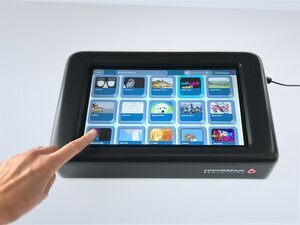
Soundbeam in it's basic and most commonly used form consists of a console, a sensor and sensor driver, a sound generator such as a sound module and amplified speakers.
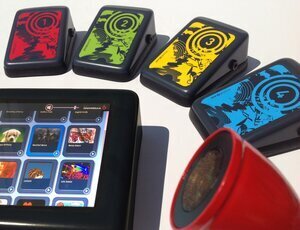
The basic system may be expanded to incorporate up to four sensors i.e. four different beams. A Switch Box may also be connected to the system enabling up to eight switches to be used for turning on and off the sounds through various switch types such as on/off, proportionate and joystick.
Education continues to be the principle field of application for Soundbeam. Soundbeam's potential for both children and adults with special needs is well established.
Performance groups are increasingly using Soundbeam. It adds an exhilarating live and improvisatory element to electronic music, it encourages choreographers, composers, dancers, musicians and technicians to collaborate in new ways.

Information and Leaflets
Manuals and Downloads
- Soundbeam 2 Handbook: Part 1 Getting Started (PDF, 800K)
- Soundbeam 2 Handbook: Part 2 Getting Started (PDF, 2.1M)
- Soundbeam 2 Handbook: Part 3 Getting Started (PDF, 850K)
- Soundbeam 2 Handbook: Appendix 1 (PDF, 2.0M)
- Pitch and setup blanks (PDF, 30K)
Technical Specifications
- Display: 2 x 16-character backlit LCD.
- Panel controls: 12 x push buttons, 1 x rotary encoder.
- Memories: 100 x 64 note/chord pitch sequences (30 locked factory presets, 70 user-definable). 128 Setups (30 locked factory presets, 98 user-definable).
- Power consumption: 38 watts (using 2 beams).
- Power supply: AC 9v.
- Dimensions: 300 (w) x 274 (d) x 86 (h) mm.
- Weight: 1850g.
- CE approvals: Radiation Emissions to EN55011 Class B.
- Conducted emissions to EN55011 Class B.
- Radiation immunity to EN61000/4/3.
- Conducted immunity to EN610004/6
- Switches: standard 1/4" jack sockets for 8 on/off or proportionate switches delivering 0-5v

Soundbox with Soundbeam (pictured right) gives particular pleasure to people with hearing impairment and other disabilities who may enjoy their first real experience of music lying or sitting on these resonators, which allow sound to be 'felt' as physical vibration. The upper surface of the platform vibrates as the user's movements generate sounds triggered by Soundbeam.
Other vibro-acoustic devices include the Soundbed and Soundchair. The Soundbox, Soundbed and Soundchair can all be connected to the speaker outputs of ordinary stereo amplifiers. A Speaker Protection Unit is supplied with each device to safeguard the speakers from damage by overloading.
For a full range of Soundbeam products please either "Contact Us" or "Request a Catalogue".